Test one: the water meter
Turn off every tap, appliance and irrigation timer. Find your meter, usually in a box near the street, and look at the leak indicator, a small triangle or dial that spins when any water flows. If it moves, water is going somewhere.
For a stronger test, write the meter reading down, wait an hour with everything off, then read it again. Any change means a leak between the meter and your fixtures.
Test two: the toilet dye test
Toilets are the most common silent leakers. Put a few drops of food coloring in the tank, wait fifteen minutes without flushing, and check the bowl. If color appears, the flapper is leaking. A worn flapper can waste a lot of water, and it is a cheap part. Our toilet repair page explains the fix.
Test three: look and listen
- Walk the house with the TV and fans off, and listen near walls and under sinks for a hiss.
- Check under every sink and around the water heater for moisture.
- Look at ceilings and wall bases for stains, bubbling paint or soft spots.
- Press a finger on suspect drywall. Soft or cool drywall holds moisture.
Test four: the outside check
Walk the lot after the meter test. A wet strip, unusually green grass or a soft patch between the meter and the house can mean a service line leak. Check the hose bibs and irrigation valves too, because a stuck valve can run all night. If the line is the culprit, our water service line repair page explains what comes next.
Test five: the hot water check
A warm spot on a slab floor, or a hot water tap that takes a long time to heat, can point to a leaking hot line. Shut off the water heater's cold supply for a while and see whether the meter slows. If a warm patch persists, read our slab leak page.
| Test | What it finds | Who can do it |
|---|---|---|
| Meter test | Any leak in the supply system | You |
| Dye test | Toilet flapper leaks | You |
| Look and listen | Visible leaks and hissing | You |
| Acoustic and thermal | Leaks inside walls and slabs | A plumber with the right tools |
| Pressure test | Which section of supply pipe is leaking | A plumber |
What a professional adds
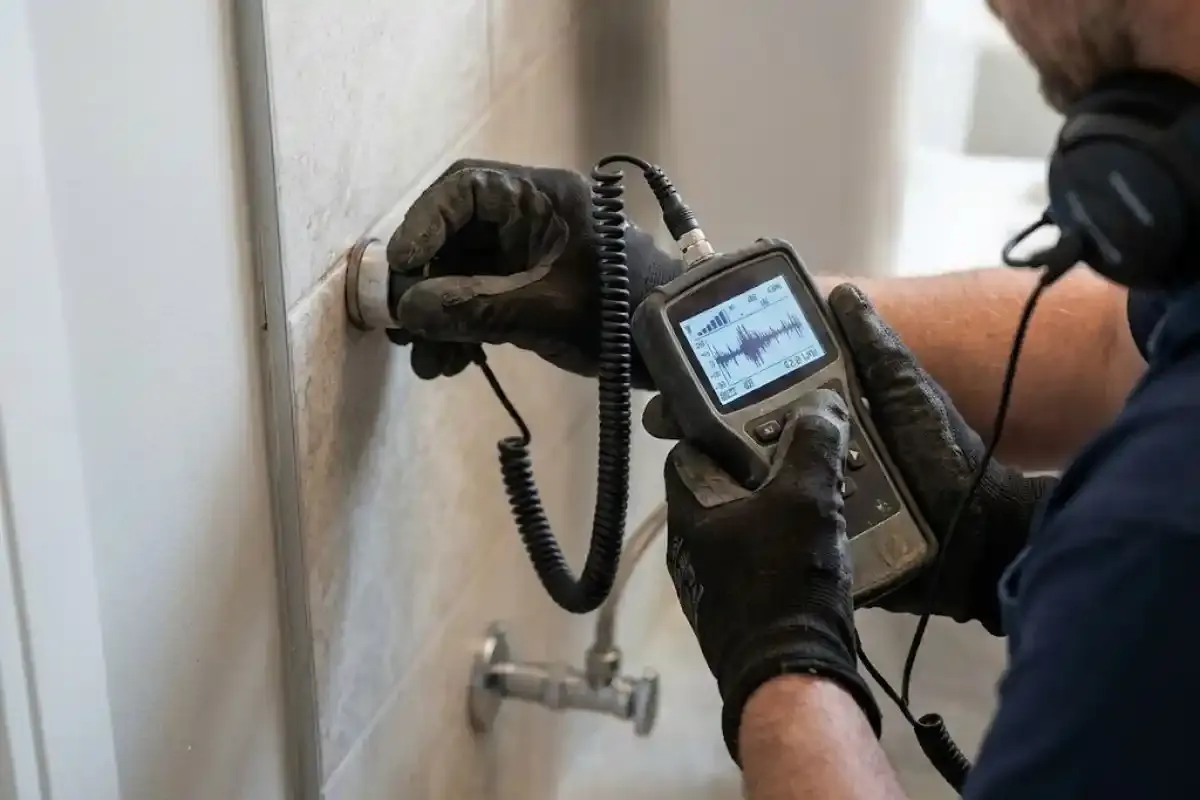
When your tests say there is a leak but you cannot see it, a plumber uses acoustic listening devices to hear water escaping through pipe and thermal imaging to show temperature differences behind surfaces. We mark the spot on the surface so the opening is small. See our leak detection page for the whole process.
Keep a record
Write the meter readings, the dates and the places you checked. If you contact your insurer, those notes help. Photograph stains and take a short video of the meter moving. A tidy record shortens the conversation with an adjuster and with a plumber.
What to do once you have found it
Stop the water
Close the nearest shutoff, or the main if you cannot find one.
Photograph the source
Take clear photos before anything is moved or dried.
Dry what you can
Fans and towels help on surface water, but open walls only with advice.
Call for repair
A plumber fixes the pipe, and a restoration company handles drying inside walls.
Do not assume the first leak is the only one. After the repair, repeat the meter test. If the meter still moves, a second leak is hiding elsewhere, and it is better to know that on the day of the repair than weeks later.
How professionals confirm a leak
A supply system can be pressure tested against a gauge, in line with the California Plumbing Code, which is based on the Uniform Plumbing Code (UPC). If the pressure falls with all fixtures closed, a leak exists. The test cannot say where, which is why acoustic and thermal tools come next.
Pleasant Hill: finding your meter and shutoff
Pleasant Hill homes receive water from different providers depending on location, and Contra Costa Water District serves part of the city. Your bill names the provider, and the provider can tell you where its meter ends and your pipe begins. The pipe from the meter to your house is generally the owner's responsibility.
Many Pleasant Hill houses were built in the postwar decades, when galvanized steel was common. If your home has it and you see rust-colored water or low pressure, a pinhole leak is more likely than in a newer house.
Our neighbors in Concord and Walnut Creek can use the same tests.
Local questions
Turn off all water use, find the meter, and watch the leak indicator or note the reading for an hour. Movement means a leak.
A toilet flapper leak, using food coloring in the tank.
Often yes, with acoustic and thermal tools.
Quickly. Water damage and mold start within days.
Generally yes. Confirm with your water provider.
Still have a question about your situation? Call (855) 575-2890 any hour and describe what you are seeing.