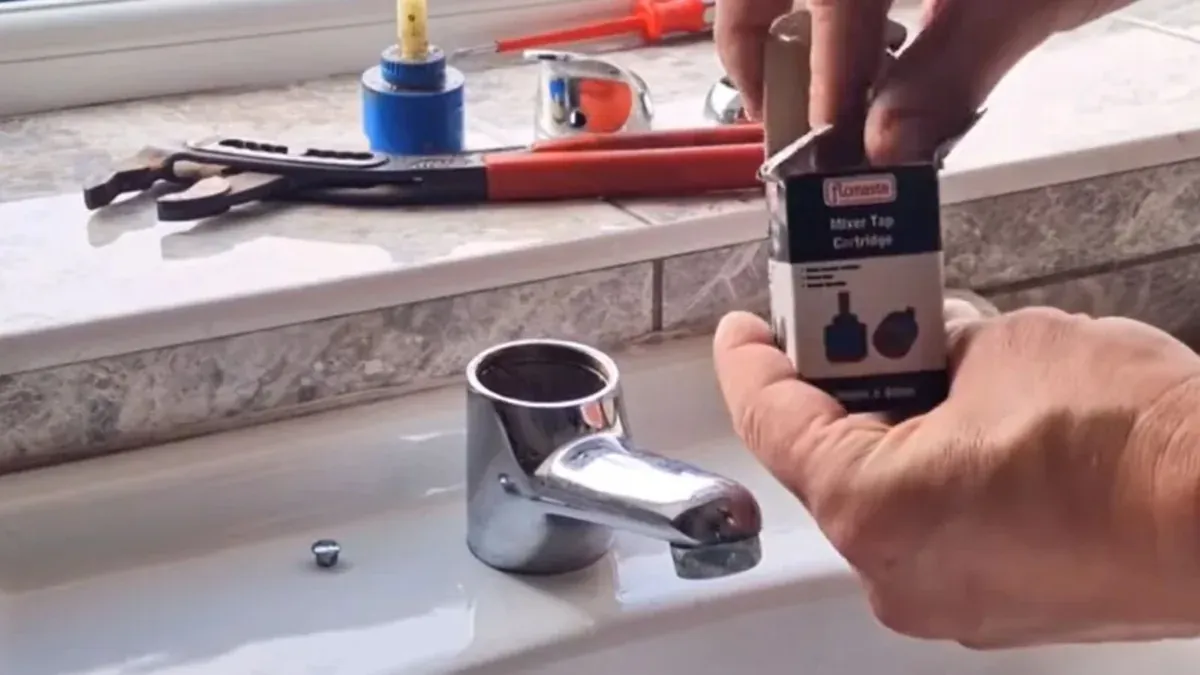
Where the faucet is leaking tells you the cause
| Where water appears | Likely cause | Usual fix |
|---|---|---|
| Drips from the spout when off | Worn washer or valve seat | Replace the washer or the stem |
| Leaks around the handle when on | Worn packing or loose packing nut | Tighten, or replace the packing |
| Water inside the wall or on the ceiling below | Cracked body or a split pipe behind the bib | Replace the bib, check the pipe |
| Water sprays from the vacuum breaker | Normal when the faucet is on, a fault if it never stops | Replace the breaker or the bib |
The third row deserves attention. A hose bib that is wet inside the wall is more than a drip. Water in a wall cavity rots framing and feeds mold, and you may not see the damage for months.
A quick repair you can try
Shut off the water
Find the shutoff valve inside the house for the outdoor line. If there is none, shut the main.
Open the faucet
Opening the bib drains the pipe so you can work.
Tighten the packing nut
A gentle quarter turn often stops a handle leak.
Replace the washer
Unscrew the stem, replace the rubber washer and reassemble.
If the stem is stuck, corroded or the body is cracked, stop. Forcing it can snap the pipe inside the wall. Our faucet repair page explains how we replace the bib safely.
Hoses left attached
A hose left attached holds water in the faucet and the pipe. In a cold snap, that water can freeze and crack the faucet body or the pipe behind it, and the crack only shows when the water is turned on again. Even without freezing, a hose under constant pressure strains the packing.
Disconnect hoses when you are not using them, and shut off the interior valve if you have one. It is a thirty-second habit that saves a repair.
Replace instead of repair
Repair when
- The leak is at the spout or handle
- The stem turns freely
- The body is not cracked
- Parts are available
Replace when
- Water shows inside the wall
- The body is cracked or corroded
- The stem is stuck
- You want a frost-resistant or anti-siphon model
Frost-resistant bibs have a long stem so the valve seat sits inside the heated part of the wall. They need a slight downward slope to drain, and an installer who ignores the slope defeats the design. A plumber sets them correctly.
When a leak is urgent
A spray or steady flow that will not stop is an emergency if you cannot shut it off. Close the interior valve or the main and call. Water running into a wall or crawlspace should be treated as active damage. Our burst pipe repair page explains the first steps.
Anti-siphon protection and why it matters
Many hose bibs include a vacuum breaker, the small cap near the handle. It keeps water from being drawn back into the house supply if pressure drops while a hose sits in a bucket or a pool. A leak from the breaker when the faucet is running is normal. A leak when it is off is not.
If you replace a hose bib, ask for a model with the breaker built in. Pairing it with a shutoff valve inside the house gives you a quick way to isolate the line during repairs and on cold nights.
Safety checklist before you call
- Close the indoor shutoff for the outdoor line if you can find it, then open the hose bib to drain what is left.
- Keep water away from outdoor outlets, lights and any extension cords near the leak.
- If water is running down a wall into the house or garage, shut the main valve and call right away.
- Do not use a wrench to force a frozen or stuck handle, since the stem can snap and open the line fully.
- Photograph the leak and the wet area before anything is dried or moved.
What the code says about hose bibs
The California Plumbing Code, which is based on the Uniform Plumbing Code (UPC), calls for backflow protection on hose connections so that water cannot be drawn back into the drinking supply. That is why most modern hose bibs carry a vacuum breaker. A replacement bib should have one, or a separate device should be added.
Pleasant Hill: cold nights and your water provider
Pleasant Hill sits in a Mediterranean climate, and hard freezes are uncommon, but the nearby foothills see cold snaps. Check exposed faucets and attic lines on the rare freezing night, and keep a towel or insulated cover on hose bibs.
Your water provider's bill names who serves your address, since Contra Costa Water District covers only part of the area. If you see mineral crust on the spout, ask your provider for its water quality report instead of guessing at hardness.
For homes toward the foothills, see the Clayton page, and for the south side the Lafayette page.
Local questions
A worn washer or valve seat is the usual cause. It is an inexpensive repair.
It is uncommon, but cold nights occur. Disconnect hoses and insulate exposed faucets when a freeze is forecast.
A hose bib with a long stem so the valve sits inside the warm part of the wall. It needs a slight downward slope to drain.
Yes. Water in a wall rots framing and grows mold, so shut it off and call.
Often yes, because the pipe behind it can be fragile and the bib must be sloped correctly.
Still have a question about your situation? Call (855) 575-2890 any hour and describe what you are seeing.