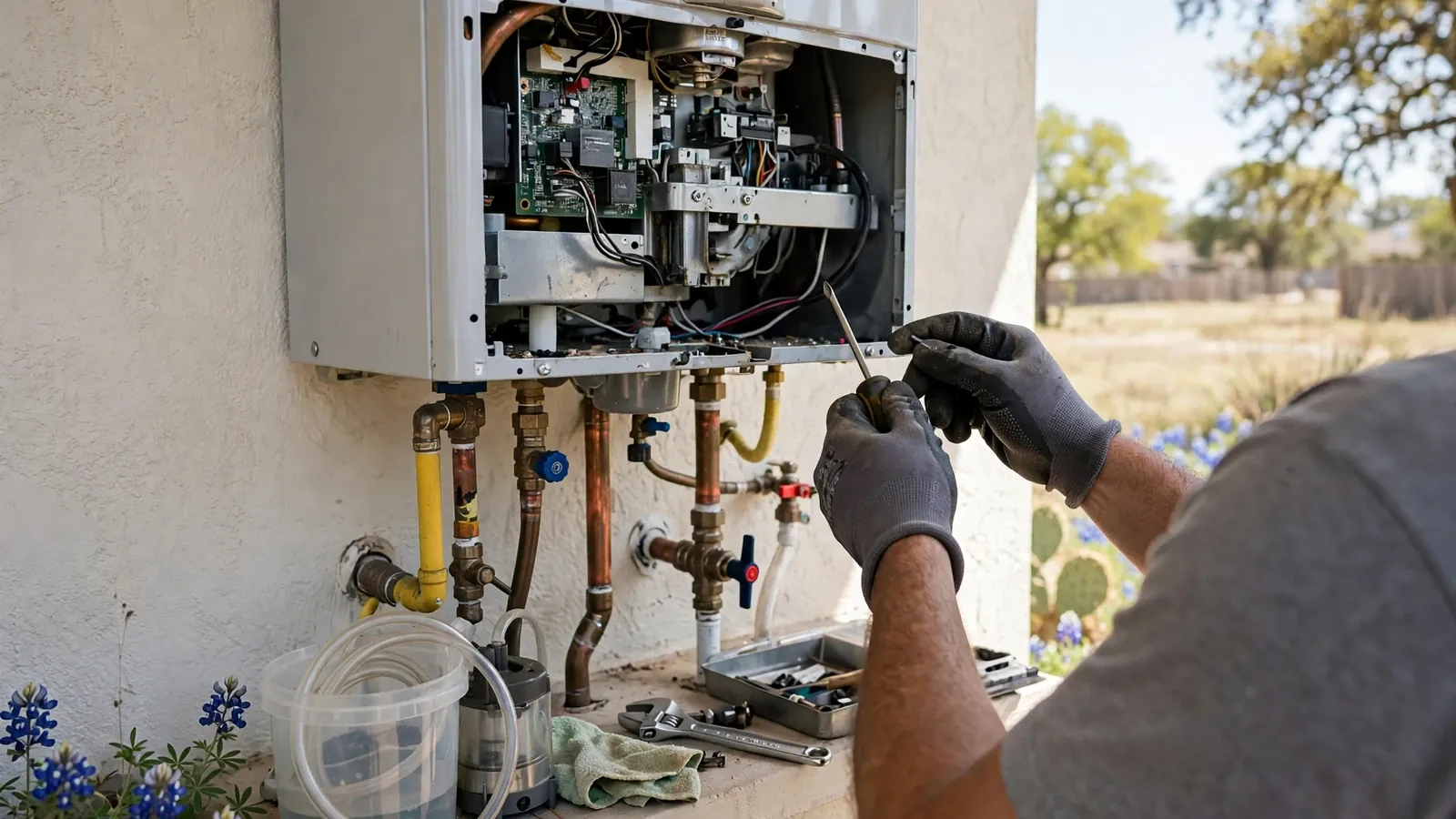
My tankless heater is lukewarm or showing a code
Callers usually start with a symptom, not the word tankless: hot water that never gets hot, a unit that clicks and shuts off, or a code on the display. Those problems often trace back to scale on the heat exchanger, a clogged inlet filter, a dirty flame sensor or an undersized gas line.
We read the code, check the filter and test gas pressure before touching the unit. Many fixes are small, and we tell you plainly if the unit needs a bigger repair.
Flush and descale: the service people skip
Minerals in tap water collect inside the heat exchanger as water is heated. A flush circulates a descaling solution through the unit to dissolve that buildup and restore flow. Manufacturers typically call for periodic flushing, and your manual gives the interval.
We do not state a local hardness figure here because we have not verified one for your address. Test your tap, or ask your water utility for its annual water quality report. Your bill names whether Contra Costa Water District or another supplier serves you.
| Maintenance task | What it prevents | When to do it |
|---|---|---|
| Clean the inlet screen | Low flow and error codes | At each flush |
| Descale the heat exchanger | Scale insulating the exchanger and reducing efficiency | Per manual, sooner with hard water |
| Check venting and condensate | Blocked intake, acid drain buildup | Yearly |
| Test relief valve and gas pressure | Safety trips and weak flames | Yearly or on service calls |
Is tankless right for your home?
Good fit when
- Gas line can be upsized
- Vent path is easy
- Household hot water use is steady
- You want to free floor space
Think twice when
- Gas supply is limited
- Venting would need major work
- Simultaneous demand is very high
- You want the lowest upfront cost
Simultaneous demand is the question to ask. Two showers and a dishwasher at once can exceed a single unit's flow, so we size by fixtures. If you are comparing options, see our replacement page for tank alternatives and the installation page for planning steps.
Tankless trouble?
Call and read us the error code. We can often tell you whether it is a quick fix or a service visit.
Installation requirements
- A gas line sized for the unit's input rating, which is usually larger than a tank's.
- A sealed vent and intake, installed to the manufacturer's clearances.
- A condensate drain on high-efficiency models.
- A shutoff valve and service valves so the unit can be flushed.
- An electrical supply for the controls and fan.
California Plumbing Code governs the work, and permit requirements vary by city. Ask the Pleasant Hill building division which permit applies.
What affects tankless service and install cost
Our price is clear before work starts. Factors:
Insurance seldom covers planned upgrades or wear. It may cover sudden water damage if a connection fails, so keep your paperwork.
Want your real number? Describe the job on the call and we quote it before work starts.
Serving your area
We service tankless systems throughout 94523 and nearby 94521 and 94549, so Lafayette and the east side of Concord are on the same schedule. The Clayton page covers those homes.
Tankless units are installed to the manufacturer's installation standards and the California Plumbing Code, which is based on the Uniform Plumbing Code (UPC). The manual's flushing guidelines set the maintenance schedule, not ours.
Common questions
Follow the manufacturer's schedule. With hard water, flush more often. Test your tap or ask your utility for its water quality report.
Common causes are scale, a dirty flame sensor, low gas pressure or a blocked vent. We read the code and test before replacing parts.
Often yes, but the gas line and vent may need upgrades. We check both first.
They heat as water flows, but flow is limited by capacity. Multiple fixtures at once can exceed a unit's output.
Most units need electricity for controls and a fan, so they stop in an outage unless connected to backup power.
Still have a question about your situation? Call (855) 575-2890 any hour and describe what you are seeing.