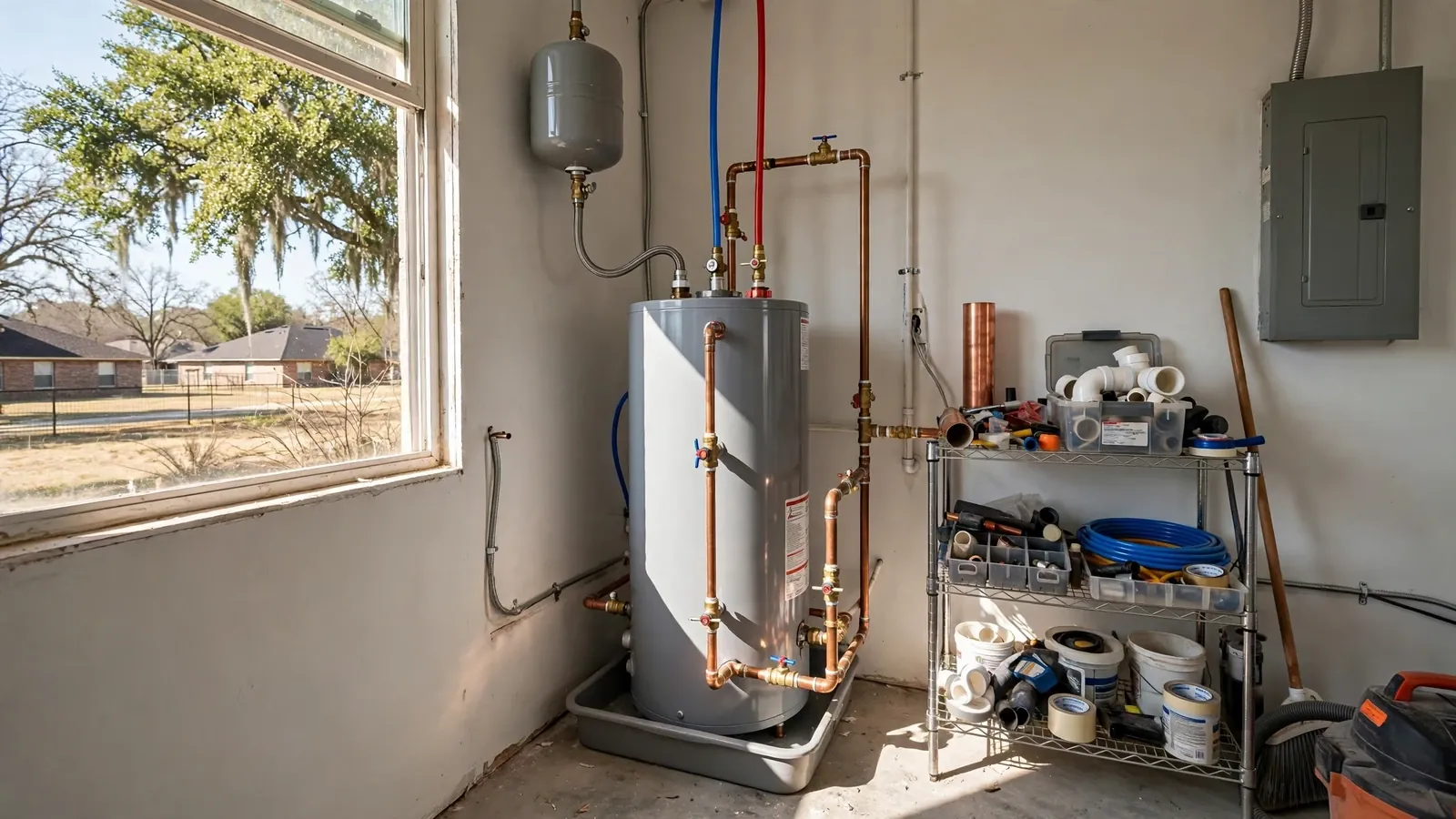
Where installation differs from replacement
Replacement is a swap in the same spot. Installation often moves the heater, changes its fuel or adds a second unit. A garage tank moved to an exterior wall, or a tank swapped for a wall-hung tankless, changes gas sizing, venting and sometimes electrical supply.
If your tank has already failed, our emergency replacement page covers that urgent path. This page is for jobs you can plan.
Planning steps before the install day
Site visit
We check the location, the gas line size, the vent path and the electrical capacity.
Sizing
We match capacity to the number of bathrooms, fixtures and people in the home.
Quote and permit
You get a clear price, and we explain what permit applies in your city.
Install and test
We set the unit, connect it, add straps and relief piping and test for leaks and gas tightness.
Tank, tankless or hybrid
| Option | Space needed | What to plan for |
|---|---|---|
| Standard tank, gas | Floor space and a vent to the roof | Vent rise and clearance, combustion air, gas shutoff, strapping |
| Standard tank, electric | Floor space, no flue | Dedicated circuit and a drain pan if the room is finished |
| Tankless, gas | Wall space and a sealed vent | Larger gas line, condensate drain, annual flushing |
| Hybrid heat pump | Open room volume for air intake | Condensate drain, noise, a clear air path |
Tankless units save floor space but need maintenance. Our tankless page explains flushing schedules and when scale builds on the heat exchanger.
Safety details inspectors look for
The California Plumbing Code governs how a heater is installed. The City of Martinez's water heater handout summarizes the items, and we use it as a checklist. It calls for two straps on a tank, with a third above 52 gallons, fastened to a stud with a lag bolt, and it prohibits plumbing tape as strapping.
It also lists a minimum 12-inch vent termination above the roof, 4 feet from any building opening, and a gas shutoff ahead of the sediment trap. Those details are the same regardless of city, so they are the standard we build to.
Ready to plan your install?
Call and we can talk through fuel type, location and timing. There is no pressure to book on the first call.
Installing in older homes
Postwar homes in the Gregory Gardens area and along Contra Costa Boulevard often have attached garages with the heater beside the furnace. Moving or replacing the unit can trigger a vent upgrade, and old galvanized shutoff valves sometimes break when touched. We budget for those surprises up front.
What affects installation cost
Price depends on the project, not just the unit:
Planned installs are not storm or accident damage, so insurance rarely helps with the cost of the new unit.
Want your real number? Describe the job on the call and we quote it before work starts.
Service area
We install units across 94523, and also in 94596 and 94598 on the Walnut Creek side. See the Walnut Creek page for the area covered, or the repiping page if your old supply lines are also due for work.
Installations follow the manufacturer's installation instructions and the California Plumbing Code, which is based on the Uniform Plumbing Code (UPC). Where the two differ, the stricter requirement guides our work.
Common questions
Planned installs are scheduled on a day that suits you. If your heater has already failed, we offer same-day appointments when available.
Yes. We check gas, water, vent and electrical capacity first and give a clear price.
Yes. We size the gas line and vent, and we show you the maintenance schedule.
California cities generally require a permit for water heater work. Ask the Pleasant Hill building division, and we will help prepare what is needed.
We install straps to code: two on a tank and a third for larger tanks, fastened to framing.
Still have a question about your situation? Call (855) 575-2890 any hour and describe what you are seeing.